
FUN IS A BRAND STRATEGY. BUT IT ISN’T THE WHOLE STRATEGY.
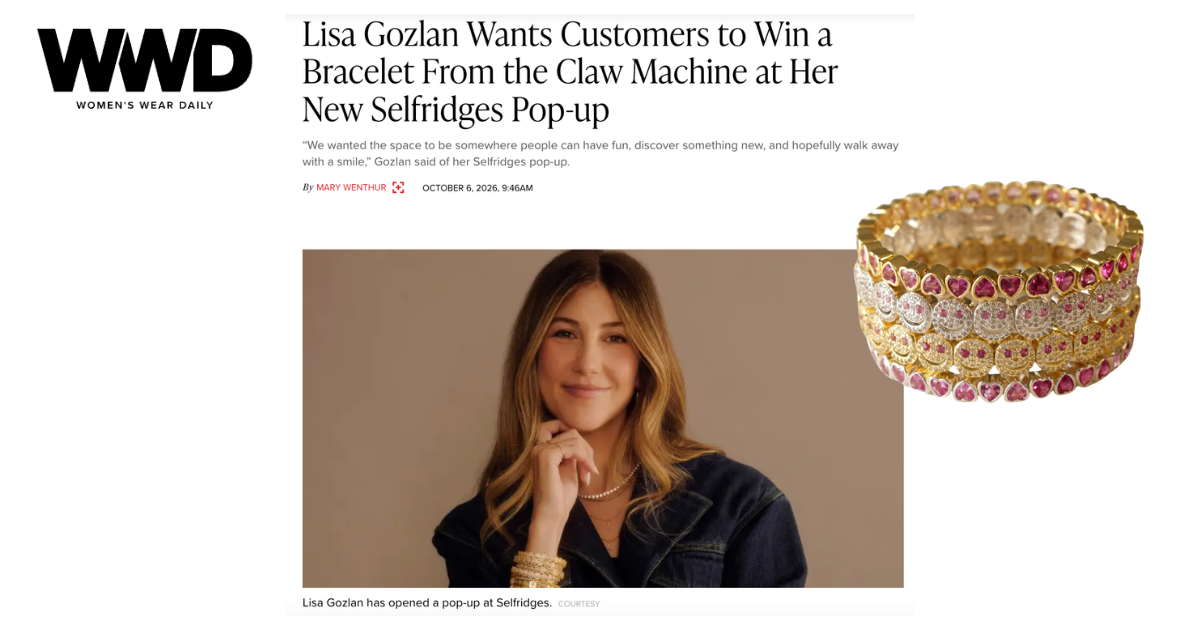
Read the full article about the Lisa Gozlan x Selfridges pop-up in WWD.
A little nostalgia can go a long way, especially when you remember that fashion is supposed to be fun.
Lisa Gozlan’s recent Selfridges pop-up is a perfect example. The jewelry brand incorporated a claw machine where customers receive a token and a chance to win a bracelet.
Simple? Yes.
Strategic? Very.
A claw machine comes with an emotional connection already built in. You know the game. You remember the anticipation. You want to play. And, obviously, you want to win.
Gozlan has taken that familiar feeling and made it part of the brand experience.
Existing customers get a moment of surprise and delight. New customers have an easy way into the brand. The activation creates a natural reason to stop, engage, photograph, share and talk about it.
But here’s the important part:
The claw machine isn’t the brand strategy. It’s what a strong brand strategy can produce.
The Moment Has to Come From Somewhere
When we build brands at SLK Brands, we spend a lot of time defining positioning, customer, voice, ethos, storytelling and content pillars.
Those exercises aren’t meant to live forever in a strategy deck.
They should eventually answer a much more practical question:
What does this brand actually DO with all of that?
What should the campaign say?
What should happen at an event?
What should customers experience when they encounter the brand?
What could make someone stop scrolling?
What gives them a reason to participate?
And what makes them remember you instead of the 47 other brands they encountered that day?
That is where strategy becomes marketing.
Creating the Moment
When I worked on the Erase the Cake campaign, we landed on a very simple idea:
“Putting on makeup is fun. Taking it off should be easy.”
There was a customer truth inside that sentence.
We love the ritual of getting ready. The products. The transformation. The experimentation. The fun.
Taking it all off? Considerably less glamorous.
That tension gave us the story.
Instead of simply marketing another product designed to remove makeup, we could enter a moment the customer already understood and then position the product as the solution.
Engage with the feeling. Then solve the problem.
That is the difference between creating marketing for a product and creating a brand world around one.
One Great Idea Is Still Only One Piece
This is also where brands can get themselves into trouble.
A clever activation is not a brand strategy.
A viral TikTok isn't a brand strategy.
A beautiful campaign isn't a brand strategy.
Neither is a tagline, influencer dinner, content pillar or claw machine.
They're pieces of the puzzle.
The real work is making sure those pieces belong to the same puzzle.
Your positioning should inform your storytelling. Your storytelling should inform your content. Your content should reinforce the customer experience. Your activations should make the brand more recognizable. And all of it should support the commercial objectives of the business.
When those pieces connect, marketing stops feeling like a collection of random tactics.
It starts building equity.
That is ultimately the work.
At SLK Brands, we don't begin by asking, “What should we post?” or “What activation should we do?”
We begin by figuring out what the brand should mean, who should care and why.
Then we create the moments that make people feel it.
Because sometimes that moment might be a campaign line.
Sometimes it's an unexpected customer experience.
And sometimes, brilliantly, it's a claw machine.